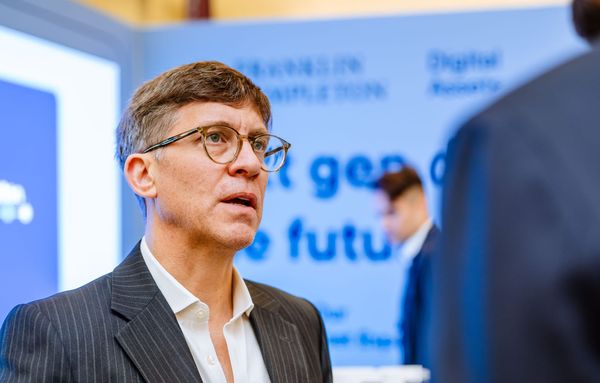
Can the Swiss Franc Go On-Chain? Interview with Johannes Kern, Managing Director at Frankencoin Association
Johannes Kern turns the usual institutional-crypto debate around: instead of asking how crypto can fit into traditional finance, he argues that decentralized systems should be compelling enough for traditional finance to adopt them.

Can decentralized systems should be compelling enough for traditional finance to adopt them? Johannes Kern is the Managing Director of the Frankencoin Association. Frankencoin is currently the largest Swiss franc stablecoin, with a money supply of more than 30 million Swiss francs.
Let’s start with the basics. What is actually a stablecoin?
A stablecoin is nothing else than a digital representation on chain of some form of an asset. It might be a dollar, a Swiss franc, you could even argue a bond. Basically, it’s referencing the value of an asset on chain, which is, relatively speaking, stable. It has less volatility than what you would find in Bitcoin or in Ethereum, or in what you would traditionally understand as a crypto asset.
Which stablecoins exist today?
The stablecoin market is pretty big. It’s roughly 300 billion US dollars at the moment, and it’s vastly dominated by dollars. About 89.9% of the whole market is USD denominated. The two biggest players are Tether and Circle.
What they do, and that’s actually quite interesting – they give you a token: one dollar, one token, one USDT, one USDC. You can always go back and redeem this token, so you get back your dollar for that one USDT/USDC. What they do is they take this money and put it mainly into US government bonds. That gives them quite a juicy yield. So that is a very, very lucrative business model, and that’s how they’ve grown to be so big.
But that’s not the only way you can create a stablecoin. This is the way Tether became big. But then there are also fully decentralized stablecoins. There are very big ones, Sky Finance or MakerDAO, which I think is about 10 billion in assets at the moment. We call it total value locked, so money in the system.
What they do is basically create an on-chain bank. You go there and deposit an asset, for example Ethereum, or tokenized gold, or tokenized real estate, or tokenized shares, and you borrow against this asset. By doing so, you are creating money. In the case of MakerDAO, it’s a DAI, or USDS in the case of Sky, which is a dollar-denominated asset backed by all those collaterals which have been put in to borrow against.
What is happening right now with the CHF stablecoin?
Switzerland is a bit of an interesting case here, and the reason is twofold. On one hand, the business model Tether has is that they are getting the yield from the dollar, the risk-free rate on the dollar. The Swiss franc doesn’t really have that. I think the short-term Gobi bonds are even negative yielding at the moment, so you can’t really have that business model. That makes it a lot harder to build this form of a stablecoin in a Swiss franc.
The second issue is that regulation in Switzerland has become very hostile. FINMA, in 2024, decided that in order to issue such a stablecoin, you need to have a bank license, and anyone who is holding that stablecoin needs to be a client of that bank. The stablecoin became basically non-transferable. You could only send it to other people that had already been onboarded to that same Swiss bank. Before that, there used to be multiple Swiss franc stablecoins, because there is a very big need for it, and this effectively shut down all Swiss stablecoin projects back in the day.
Which stablecoin is successful in Switzerland now?
Right now there is one stablecoin that is really successful, and that is Frankencoin. It’s about 95% of the market, with about 80 million US dollars in total value locked. This stablecoin is, again, not like Tether or Circle. It’s like MakerDAO or Sky. It’s fully decentralized, and that is quite interesting, because this is something that is not touching the traditional financial system. It’s living completely on chain. It’s completely transparent. It has no issuer, and that is why it cannot be regulated. However, it is fully compliant, because both MiCA and the American provisions have exemptions for fully and properly decentralized systems.
What is the reason for that?
The reason for that is quite clear. Regulation has a reason. Regulation is there to protect investors, to protect the stability of the financial system, and to prevent money laundering. You can do this with regulation, by forcing issuers, who would be very non-transparent and would do whatever if they were not regulated, or you can achieve those same goals with a fully transparent and self-enforcing system. Even if you wanted, you could not use Frankencoin for any of those nefarious purposes. It’s very clear what it does, because it’s written in code, and that code is on chain. These are smart contracts, which are non-changeable. So when you use the system, you can be sure that it will always work how it was coded, and no one can just go and change things.
Is anyone else doing it?
Right now, there is not a single player doing centralized stablecoins. There is just Frankencoin, which, technically speaking, has an association, but the association is not the issuer, so it has no jurisdiction. It’s just issuing a Swiss franc stablecoin as the system, not as an entity behind it.
The only other live one that exists is the Allunity CHF, AU, which is issued under MiCA from Germany. I’m Swiss, so I find it quite funny that the first Swiss franc stablecoin comes from Germany, because the Swiss cannot get a grip on making things that are actually executable. It’s a very small stablecoin. I think it’s about five million in assets at the moment. It’s not very liquid yet. We’ll see where it goes. We are working closely together with them, so there is a bridge, and we as the association are in close contact with the Allunity team in Germany, because we believe everyone in the end profits from a bigger Swiss franc stablecoin.
If you take a step back, what do you use stablecoins for?
I’d say there are two main use cases.
The typical use case of USDT and USDC is cross-border payments, because it’s just vastly more efficient to use a stablecoin instead of the old inefficient banking rails, which take multiple days and are very expensive. With stablecoins you have a 10-second settlement time, and it’s final. The money is there. The dollar is perfectly fine for that, and you don’t really need other currencies, because with such efficient and quick settlement you don’t need multiple pairs.
Have launch or announcement to make? Contact The Next Vertical.
What could be a practical example?
Let’s say I’m thinking in Swiss francs and I want to send you money, and you’re thinking in Kenyan shillings. Today, you have to have a very liquid Kenyan shilling–Swiss franc market, which is already how it works, but it’s a lot more efficient with stablecoins. The only thing I then need is a very liquid Swiss franc–dollar market, and there needs to be a liquid shilling–dollar market. Because you have these 10-second settlement times and super low transaction costs, instead of going through Nostro and Vostro banks and super complicated pathways, we just literally go Swiss franc to dollar, dollar to Kenyan shilling. Ten seconds. Done. That means non-dollar stablecoins are not that relevant or big as transactional currencies.
Is there another use case?
Yes, and that is store of value. More and more people are looking to hold their assets in a digital form, be that stocks, gold, Bitcoin or stablecoins. If you look at the store of value use case, the dollar is not very good. In many parts of the Global South, Latin America being a very good example, the dollar is seen as a super stable currency. It’s stable against the Venezuelan currency or the Argentinian peso. However, against the Swiss franc, it’s not very stable. In fact, since 1971, it lost about 85% in value against the Swiss franc. That’s not a secret. It’s widely known, and that’s also why the Swiss franc plays a very big role in traditional finance as a store of value, a risk-off asset.
Bringing it into the digital world gives a vastly bigger population access to this hedge. It’s not necessarily easy to get Swiss francs from a normal bank if you’re not in Switzerland. So that is the real big use case of a Swiss franc stablecoin. It’s a risk-off asset which you can hold, and that is in very, very high demand globally.
How can the blockchain industry become credible for institutional investors?
There are really two ways. Either you bend over backwards and make the crypto industry compatible with traditional finance, and basically lose almost all of its advantages. Or you build a system that is so good that the traditional financial system says, “Hey, actually, this is a lot better than what we’re doing right now. We’re going to plug into this.”
What is the role of Frankencoin Association?
The Frankencoin Association is a steward. The Frankencoin system itself is fully permissionless and decentralized. No one owns it, no one controls it. The Frankencoin Association is a nonprofit association in Switzerland that has the task of doing education, for example, talking about it. We have engineers working in the association that are building tooling on top of the Frankencoin protocol, user interfaces, things which allow people to see it, to understand how it is.