AI Agents, Stablecoins and 24/7 Finance: What CV Summit 2026 Revealed
AI agents need always-on money, clear mandates and human accountability. CV Summit 2026 in Zurich put AI, stablecoins and tokenized assets on one agenda. Here are the key findings on 24/7 settlement, agent liability and what banks should do next.

AI Agents, Stablecoins and 24/7 Finance: What CV Summit 2026 Revealed
According to speakers at CV Summit 2026, AI agents will push banks toward always-on settlement, machine identities and programmable spending limits. Today’s financial system assumes humans who work office hours, markets that close and batches that settle on schedules. Agents do not follow those rules. Speakers pointed to stablecoins, tokenized deposits and tokenized collateral as candidate infrastructure, and to clear accountability as the condition for using them.
Key takeaways
- Agents need always-on money. Closed markets and batch settlement were described as human-era constraints.
- Stablecoins were framed as settlement infrastructure, not as crypto products. Liquidity on the cash leg is the real constraint.
- Tokenization matters most for collateral, where faster, transparent settlement could reduce operational failures.
- Liability stays with people. A recurring message was that an AI agent cannot be held accountable, so a named human or firm must be.
- “Humans in control” was proposed as a stronger standard than “human in the loop”.
- Banks need to become crypto-literate, not necessarily crypto-native.

What was CV Summit 2026?
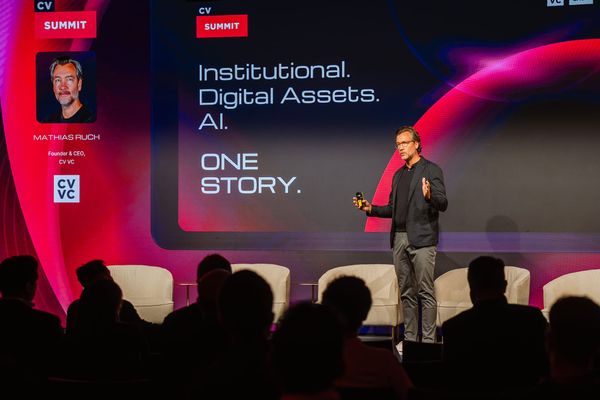
CV Summit 2026 took place on 29-30 September at the Kongresshaus in Zurich. The organizers report more than 200 speakers, 70+ sessions, 60+ partners, 150+ institutions and 1,400+ scheduled meetings. Sessions covered tokenization, stablecoins and payments, AI in finance, and wealth and asset management, with participants from banks, asset managers, payment companies and blockchain infrastructure firms. The recurring theme was convergence: AI agents need money that moves without waiting for a human click, and institutions must decide how to control, audit and trust systems that run continuously.
Why do AI agents need new payment rails?
Current infrastructure was built around human working hours. Markets close, batch clearing delays settlement, and weekend closures can force institutions to hold extra collateral because they cannot act when markets are shut. One speaker argued that markets naturally run around the clock and that closing hours are a human-made constraint (see our interview on 24/7 markets).
A payments-side example made the case concretely: if a large sum lands in a corporate account at 3 a.m., a treasury agent should be able to invest the surplus or hedge currency risk before the CFO wakes up. But agents cannot present a passport or sign a bank form. They need machine identities, permissions, spending limits and money that settles instantly, which is why stablecoins, tokenized deposits and programmable payment infrastructure kept coming up.
Are stablecoins becoming financial plumbing?
The framing shifted from crypto product to settlement infrastructure. Speakers said stablecoins can offer a better cross-border experience than today’s bank rails and described them as a wake-up call for the industry. One view was that settlement speed is now the first institutional question, and that settlement taking longer than an hour does not work for institutions.
The constraint is liquidity. A tokenized asset can only move instantly if the cash side of the transaction moves as fast, so stablecoins, tokenized deposits and instant-settlement infrastructure have to develop together.
Why does tokenization matter for collateral?
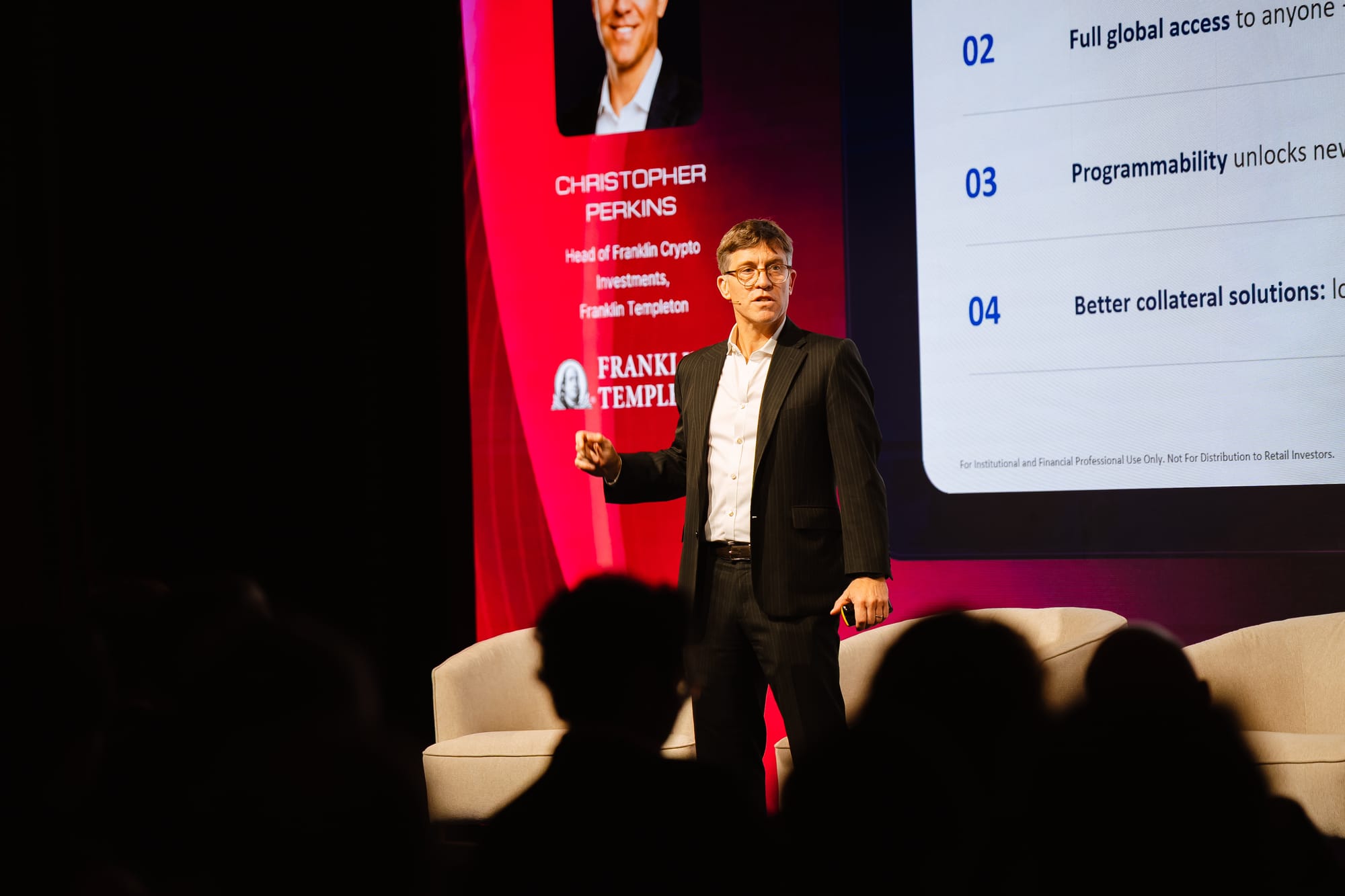
Speakers moved the question from “can an asset be put on-chain?” to “does it improve collateral, settlement and liquidity?” One example cited was a tokenized fund where holders keep earning yield until the moment of transfer and can post fund shares as collateral. Another speaker called collateral management the biggest use case, arguing that transparent, atomically settled on-chain collateral could reduce the operational failures that have historically affected OTC markets.
Demand is still an open question. A speaker noted that many tokenized assets are currently held by DeFi protocols rather than traditional institutions. The next phase depends on whether banks and asset managers see enough benefit in holding an on-chain version of an asset they can already hold through existing systems.
Is the real AI problem the model?
Several speakers said no. They argued that organizations fail when they automate old processes instead of redesigning how work is done. One suggested a better test than counting AI licenses: how much has the working day actually changed? Banks, they said, need to move at two speeds, fast for employees using AI daily and careful for autonomous agents in critical financial systems.
Another speaker said culture will be the next frontier. As agents increasingly interact with clients, they will embody an institution’s decision-making culture, so firms must decide how AI should behave when no one is watching. For a founder’s view on where startups can build value in finance, see our interview: build the middleware, not the model.
Who is responsible when an AI agent makes a payment?
This was the central governance question.
- Humans in control. One speaker rejected “human in the loop” as a sufficient control. The proposed model: every agent operates inside a deterministic workflow, has a kill switch and has a named human owner who stays accountable.
- You cannot sue the agent. Legal experts made the same point from different angles: liability ultimately sits with the person or firm behind the agent, and few AI vendors absorb liability when systems misbehave. Institutions therefore cannot rely on the model provider to manage operational risk.
- Trust by architecture. Another view was that stablecoin micropayments can cap an agent’s spending and that on-chain logs can create an audit trail of every action.
Summary of findings
| Theme | Finding | Implication for banks |
|---|---|---|
| Always-on markets | Closed hours are a human-made constraint | Plan for continuous operations and collateral movement |
| Treasury agents | Surplus cash should be deployable at any hour | Define agent mandates and limits |
| Settlement speed | Slow settlement is a barrier to institutional adoption | Test cash-leg speed, not only asset movement |
| Control | Humans in control, not just in the loop | Deterministic workflows, kill switches, named owners |
| Liability | Responsibility sits with the person or firm behind the agent | Assign accountability before deployment |
| Collateral | Tokenization is most useful where it improves collateral and liquidity | Prioritize collateral use cases over simple representation |
What should banks do next?
Financial institutions do not need to become crypto-native overnight, but they do need to become crypto-literate. One speaker argued that banks can serve digital-asset founders without becoming crypto-native, provided they understand the technology and bank the person behind the company rather than the crypto label.
Practical next steps drawn from the sessions:
- Map agent-ready workflows in treasury, payments, collateral and settlement.
- Define agent mandates: spending limits, approved counterparties, escalation rules and a human owner.
- Build control layers: deterministic workflows, kill switches, audit logs and continuous monitoring.
- Test stablecoin and tokenized-deposit settlement, focusing on liquidity, reconciliation and cash-leg speed.
- Assign accountability for agent actions before deployment, not after an incident.
Why does this matter for Switzerland?
Switzerland’s DLT framework entered into force in phases in 2021, and several banks now offer digital-asset access. The message from the summit was that the country cannot rely on having been early: if major US banks launch 24/7 tokenized-securities markets, Swiss institutions cannot wait years to respond. Speakers framed the opportunity as combining Swiss institutional trust, banking depth and regulatory credibility with faster-moving global markets, rather than copying other financial centers.

Frequently asked questions
How will AI agents change payments?
AI agents will need to initiate, approve and settle payments continuously. That pushes banks and payment companies toward instant settlement, machine identities, programmable permissions and stablecoin or tokenized-deposit rails.
Why do AI agents need stablecoins?
Agents cannot use bank cards or sign payment instructions the way humans do. Stablecoins can provide programmable, always-on money with spending limits and on-chain audit trails, although liquidity and regulation remain open issues.
What is agentic finance?
Agentic finance is the use of AI agents to perform financial tasks such as treasury management, payments, trading, reconciliation and collateral management, usually under defined human oversight.
What are the risks of AI agents in banking?
Unauthorized actions, weak controls, security failures, unclear liability, model errors and insufficient auditability. Institutions need human ownership, deterministic workflows, kill switches and continuous monitoring.
Who is liable when an AI agent makes a mistake?
Speakers at CV Summit argued that liability sits with the person or firm deploying the agent, and that AI vendors rarely absorb it. Institutions should assign a named human owner and document accountability before deployment. This is not legal advice.
What was CV Summit 2026 about?
CV Summit 2026 focused on the convergence of AI, digital assets, stablecoins, tokenization and institutional finance. It took place in Zurich on 29-30 September 2026.
This article summarizes themes discussed at CV Summit 2026. It is not legal, financial or regulatory advice. To report an inaccuracy, contact us.