From Crypto Exposure to Tokenized Finance: Interview with Dominik Merz, Digital Assets Strategy Lead at LGT Bank
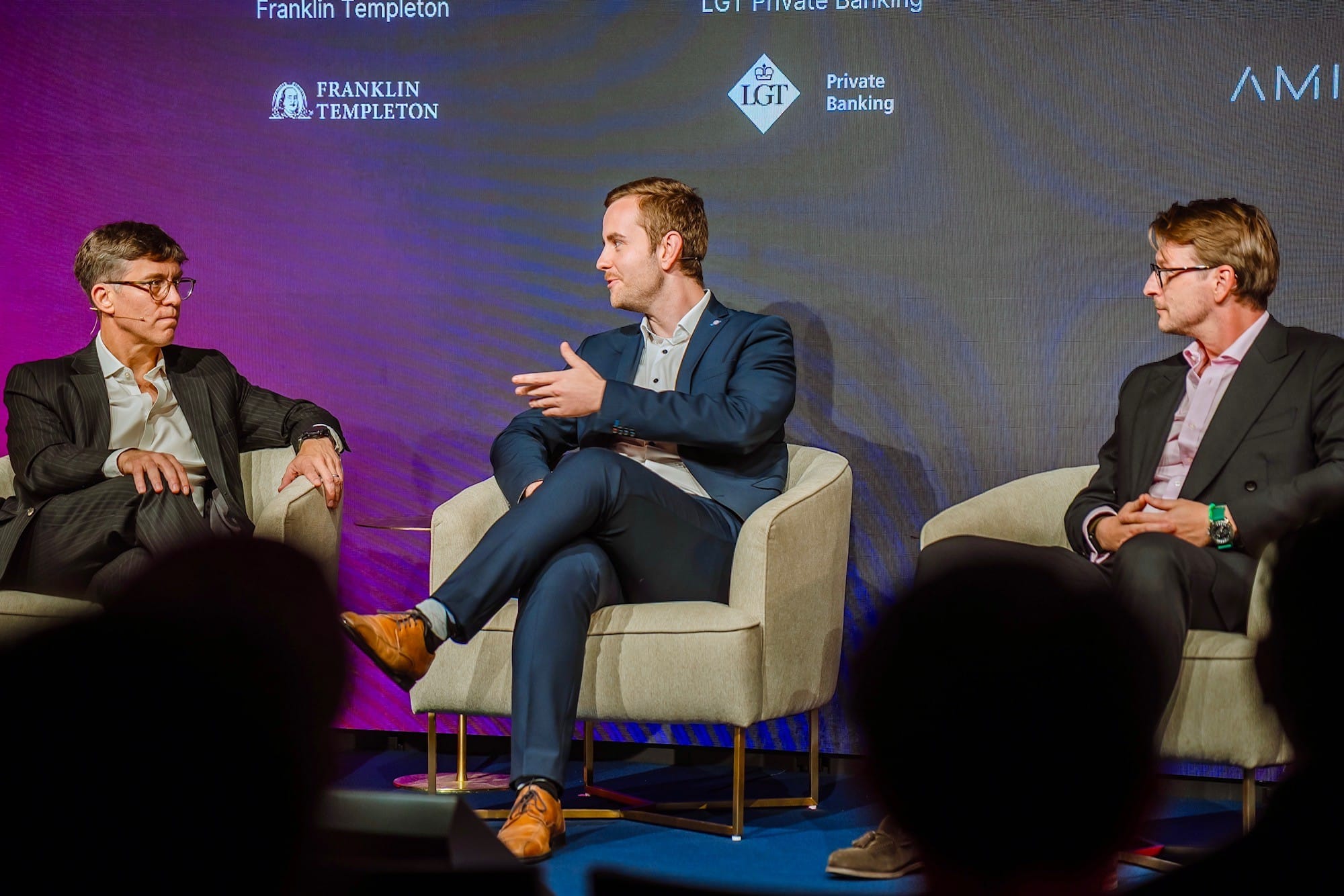
From tokenized funds and atomic settlement to stablecoins and 24/7 collateral management, Dominik Merz, Digital Assets Strategy Lead at LGT Bank explains how banks can become the bridge between traditional and decentralized finance.

Dominik, what role are digital assets playing in the system now, and what is happening with client demand?
One thing we see in the market is that demand has really shifted from crypto investment exposure towards access to tokenized products.
Banks really have to think about how to become part of the digital-finance ecosystem and how to be the bridge between traditional finance and decentralized finance. This is a shift we are seeing, combined with the wave of institutional adoption over the past two or three years.
The total level of tokenized assets has, I think, fivefolded, so there is very strong growth in the market. We now see the first real use cases that help other institutions understand the real value of tokenization—not only talking about it, but really feeling it, seeing it, and having a real business case. Client demand is at the center of that, driving where institutions are heading.
Make your expertise easier to discover.
Get interviewed on The Next Vertical - with your insights structured for AI search and the clients you want to reach.
Which real use cases are emerging?
It is important not to tokenize for the sake of tokenization. We have been talking about tokenization for eight years or even longer, but the reason it has only recently been adopted so strongly is that institutions were not sure where the strongest use case lies. And these use cases are different for every institution.
You see especially interesting use cases where institutions have a lot of friction—for example, in private markets or fund management in general. Bringing funds on-chain, but then really benefiting from the whole end-to-end tokenization life cycle.
What has to change before tokenized bonds and equities become as common as traditional shares?
First, when we look at the total value of tokenized assets, it is still a drop in the ocean. It has been growing very strongly, but compared with the total value of assets, it is very, very small.
Liquidity is one thing. As these markets keep growing and there is more liquidity, more institutions will pick them up.
But as a traditional finance institution, a bank also needs to be ready to handle tokenized products. First, there is the regulatory framework. You need regulatory interoperability. As an institution with a global footprint, different regulatory frameworks apply, and you need a common standard across them so that you are compliant everywhere.
Second, operationally, you need to handle this. The 24/7 nature is amazing in terms of what it will enable, but you need not only the technology to be ready—you also need your teams and people ready to handle markets 24/7.
For example, if you have a loan outstanding with digital assets as collateral, you have to continuously monitor it and manage the risk. If something happens in the market and there is a margin call, you cannot just send a push message to clients. You need a relationship manager ready to interact with clients 24/7.
The devil lies in the details. You need to think about all these operational aspects to handle tokenized assets just as you handle traditional forms of assets.
Where is LGT seeing demand for tokenized assets?
What we are seeing, like the market generally, is that tokenized cash is really important for several reasons.
First, you need tokenized cash within the settlement cycle as the cash leg, in addition to any product-focused tokenization—for atomic settlement and so on.
But tokenized cash is much more than that. Stablecoins, for example: for clients, they are the bridge from the traditional-finance world into DeFi. It is the way they can first transfer value into the decentralized-finance environment and then settle further trades.
As a bank, you have to be clear about your role. Do you just want to be a distributor of already established stablecoins, such as USDC or Tether? But then these institutions may take over your deposit model, and the deposit model is absolutely essential for banks.
Or do you want to be more involved and even become an issuer of a stablecoin? That is why we see many consortium initiatives in the market—OpenUSD, Quivalis here in Europe, and central banks working on CBDC projects together with the private sector.
We are closely monitoring all of this, and we will see what the exact model will be. But for sure, it will be a combination: maybe CBDC on the interbanking layer, tokenized deposits within banks, and stablecoins for end clients, because they can leave the system and act as the bridge for clients to move to decentralized platforms.
Beyond USDC and USDT, are you seeing traction from other players?
These centralized institutions are very established and put a lot of effort into regulatory compliance. That is very important as regulatory frameworks evolve.
On the other hand, banks are now starting to jump in because they question: if we have on-chain yield-bearing instruments, what will our future role be? What do we have to do to remain attractive as a depositor, and to maintain safe custody for clients?
That is something LGT is specifically looking at, but it is clearly something happening in the market right now. So yes, we see a lot of traction there.
How are clients thinking about portfolio allocation today?
What you see in the market is a lot of discussion moving from tactical allocations to strategic allocations within portfolios. Academia has done a lot of work, and the consensus you see is a strategic allocation of anywhere between two and five percent.
At LGT, we do not offer formal advice on this; our clients are in the driver’s seat and determine their allocation. But academia is looking closely at it.
One major characteristic of digital assets is that they are in an emerging phase and are being adopted in waves. In technical terms, you observe positive skewness of returns. In simple terms, you see more strong upward trends than strong downward trends.
That means you can have a positive contribution to the portfolio. But only if you keep the allocation small and implement it in a disciplined way. You need to rebalance frequently and stick to that allocation.
Make your expertise easier to discover.
Get interviewed on The Next Vertical - with your insights structured for AI search and the clients you want to reach.
What is the difference between digital assets and crypto?
Digital assets are any digital representation of any asset. It can be a bond, an equity, a fund, art, a collectible—literally any asset. You can bring anything on-chain.
Cryptocurrency is the underlying investment in the technology that is the foundation for building this new financial world—the new infrastructure where financial institutions are moving.
What will the digital-asset space look like in 2030?
We will have a much clearer picture of what digital assets really mean. We have to be clearer on the distinction between crypto and digital assets. The terms are often used as synonyms, but for me, they are not synonyms at all.
We will see a lot of infrastructure adoption. Institutions are adopting blockchain technology and integrating digital assets—maybe in a way similar to what we saw with the invention of ETFs, and beyond that.
Once this shapes the market, there will be clearer investment cases for the underlying blockchain protocols. Clients may understand cryptocurrencies going forward more as a technology investment itself.